This Page is Home Sustainability
 SocialSecuring and Developing Human Resources
Securing and Developing Human Resources

Securing Human Resources
We place strong emphasis on securing human resources to drive sustainable corporate growth, advance globalization and take on challenges in new fields such as offshore wind power. While expanding our business, we also address the reduction of overtime work by implementing strategic recruitment initiatives and strengthening both on-site replacement staffing and back-office functions. In addition to new graduate recruitment, we aim to create a workplace where diverse talent can thrive through mid-career recruitment, employment of global talent, and support for the continued success of senior employees aged 60 and above.
New Graduate Recruitment
For new graduate recruitment, we base our approach on "personality first," "no academic requirements," and "no nationality requirement," adopting a fully open application system and focusing on dialogue with students in our recruitment activities. We aim to hire approximately 200 individuals each year.
Mid-Career Recruitment
We actively promote mid-career recruitment to leverage the skills they have gained through various external careers to enhance our organizational strength. Our goal is to hire approximately 20 professionals each year.
Global Recruitment
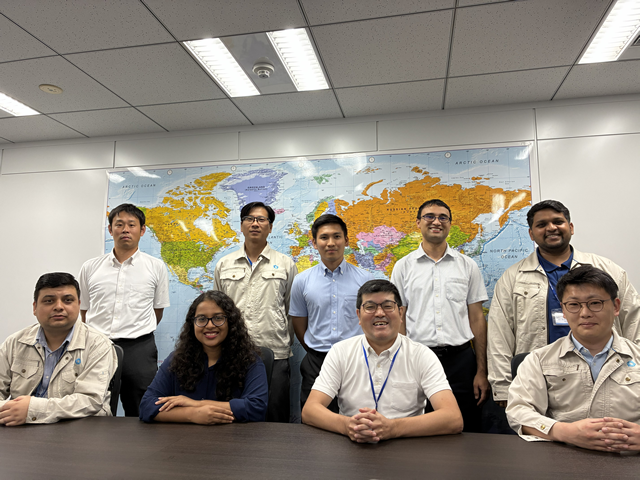
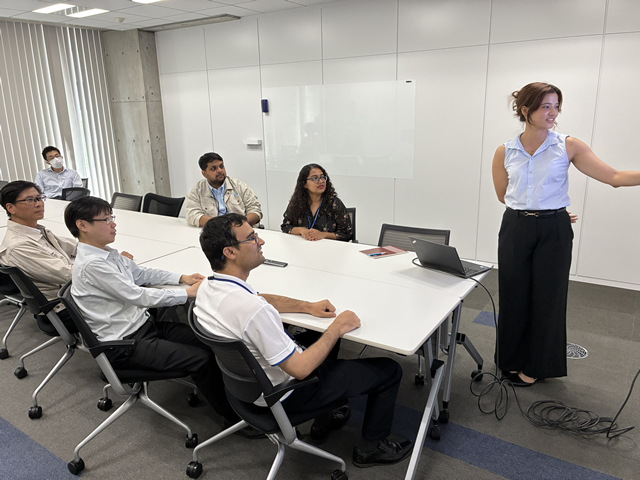
We hire outstanding international students whose native language is not Japanese (from universities and graduate schools in Japan and ASEAN region nations) every year. Following employment, we provide Japanese language education and training to help them grow into human resources who can play active roles both domestically and internationally.
Internships
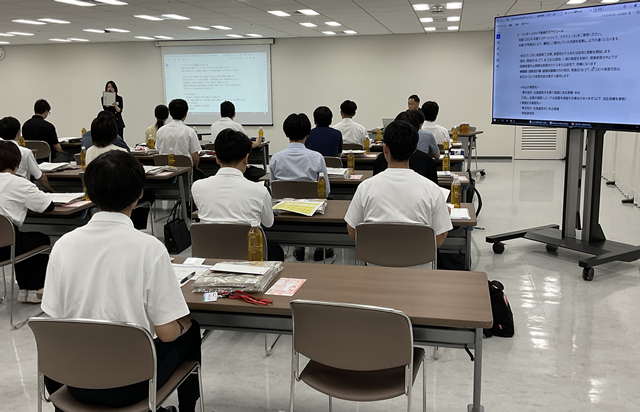
To help students better understand the industry and provide opportunities for work experience necessary for future career decisions, we accept approximately 200-300 interns each year.
Employee Retention (Turnover Prevention)
We strive to communicate our company's strengths and working environments clearly during the recruitment process to prevent post-hire mismatches among both new graduates and mid-career hires. After joining, young employees are supported through OJT and a mentor system that fosters open communications and helps ease their professional concerns. Additionally, we hold opinion exchange meetings (training and social gatherings) at headquarters and each branch to foster connections among young employees, reduce turnover and enhance their engagement.
Promotion of Reemployment (Job Return System)
We offer opportunities for former employees who left due to career changes or family circumstances to return to Penta-Ocean Construction through the Job Return system. To encourage more former employees to rejoin POC and contribute as immediate assets, we removed the previous eligibility criteria in FY 3/26, which had been limited to individuals who had left POC due to childcare, family caregiving and a spouse's job transfer.
Human Resources Development
Personnel System
Our personnel system presents a clear vision of the qualities we value in our employees, encouraging them to pursue higher-level roles and actions. By continuously developing and cultivating professional talent, we aim to enhance both corporate performance and employee self-fulfillment.
To realize the following three important points of the personnel system, we established the "Role grading system," "Target management system," "Personnel evaluation system" and "Competence development system," and implement them on an ongoing basis.
- To identify the strengths, weaknesses, and aptitude of each employee and link these factors to their future skill development and appropriate assignment at POC
- To develop a system that motivates employees and leads to revitalization of the Company
- To ensure fair treatment of employees
Global Personnel System
Since FY 3/18, we have introduced a personnel evaluation system for locally-hired employees staff in Singapore and Hong Kong which are major bases for the International Business Unit, and in July 2018, we also introduced a grading and remuneration system.
The personnel evaluation system aims to motivate goal achievement, promote talent development, and facilitate communication between supervisors and subordinates. The grading and remuneration system is designed to provide appropriate incentives for performance and goal achievement, and by reflecting the performance and evaluation of the International Business Unit in remuneration, it enhances engagement of the locally-hired employees toward achieving their goals.
Performance Evaluation, Evaluator Development and Fair Compensation
Creating a Working Environment that Encourages Challenges
We emphasize goal setting and follow-up to achieve both employee self-fulfillment and corporate performance improvement.
At the beginning of each fiscal year, employees meet with their supervisors to set individual goals that are challenging yet attainable. In the mid-term, supervisors follow up with employees on their goal through daily work and regular interviews to encourage achievement of the goal as well as personal growth.
At the end of the term, evaluation is determined by the degree of achievement of goals and the level of effort (behavior and attitude) demonstrated, and the results are fed back to the individual, increasing the individual's acceptance of the results and clarifying their growth challenges for the following year and beyond.
The labor union and management jointly conduct an annual survey on the operation of the personnel system. Based on the survey results, we ensure that the real voices of employees are reflected in the operation of the system.
For Conducting Proper Evaluation
Evaluators hold the greatest key to the success of the operation of the personnel system. We conduct annual training for newly assigned evaluators on an ongoing basis to familiarize employees with the purpose of personnel evaluation and to minimize/eliminate inconsistencies in evaluation skills. At regular intervals, we also conduct evaluator update training for all evaluators and managers.
Fair Treatment
We emphasize goal setting and follow-up to achieve both employee self-fulfillment and corporate performance improvement. To promote understanding of the purpose of performance evaluation and ensure consistency and clarity in evaluations, newly appointed evaluators receive annual training on an ongoing basis.
Furthermore, in the implementation of evaluations, the first, second, and final evaluations are conducted by multiple supervisors, ensuring that evaluations are not influenced by subjective assessment of evaluators.
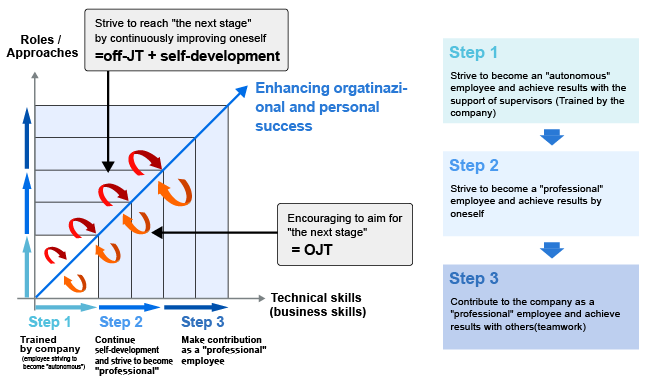
On the Job Training (OJT) & Off the Job Training
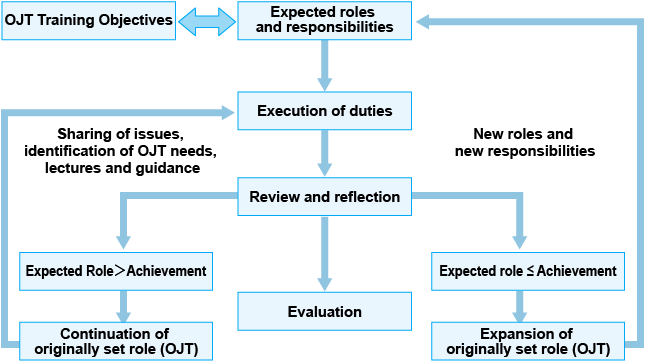
The construction industry is often described as "experience engineering". This is based on the idea that on-site experience is the key to develop personal skills.
Since professional growth through work (OJT) is imperative in the construction industry, we appoint a senior employee as the OJT supervisor for each new employee to provide guidance and support.
By clarifying each individual's "growth steps," visualizing the path to goal achievement, and providing detailed education, we promote a "co-educational culture" in which both trainer and trainee can grow together. By involving the entire workplace in the growth of new employees, we aim to promote growth in an environment where they feel supported.
At the same time, we conduct Off the Job Training (Off-JT) to acquire knowledge, skills, perspectives, and ways of thinking that cannot be gained through experience alone. We conduct rank-based training according to the growth stage of job competency, as well as job-specific training organized by each division to acquire specialized knowledge. For younger employees, we also provide communication training to foster autonomy by improving foundational business knowledge and strengthening trust-based relationships.
Support System for Obtaining Qualifications and Support Grant System for Self-development
We encourage our employees to obtain the official qualifications and licenses required for work in the construction industry, and provide a comprehensive backup as part of our Self-Development System, such as organizing in-house training sessions, covering exam fees and other costs, as well as offering achievement-based incentives aligned with the significance of each qualification. In addition, to support employees engaged in self-development, we established the Support Grant System for Self-development in FY 3/24.
In addition, we provide various learning opportunities including opportunities for employees to choose and attend external training programs of their choice.
Training in job-specific young employee development programs
We implement job-specific young employee development programs organized by the Civil Engineering Divisions Group, Building Construction Divisions Group, and Corporate Administration Divisions Group to support the acquisition of specialized knowledge.
Civil Engineering Divisions Group
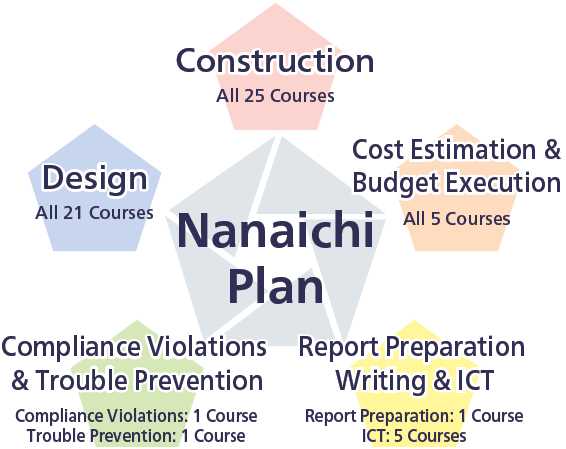
"Nanaichi Plan," a Job-Specific Young Talent Development Program
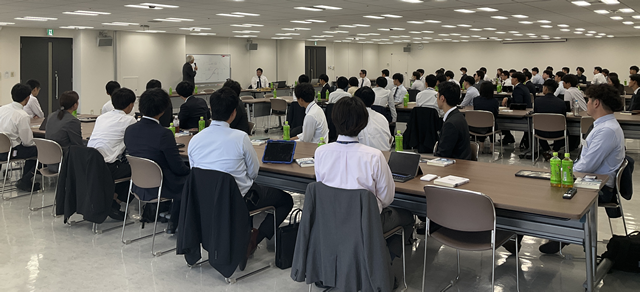
In the Civil Engineering Divisions Group, we implement the "Nanaichi Plan," a young talent development program where employees acquire essential job-specific knowledge over seven years. The curriculum systematically covers key areas required for a fully qualified civil engineer, such as construction, design, and cost estimation. In addition to in-person courses, content is available anytime via YouTube and e-learning platforms. Some courses are also available in English, making them accessible to global career-truck employees and other global employees.
Building Construction Divisions Group
"Task Support Center"
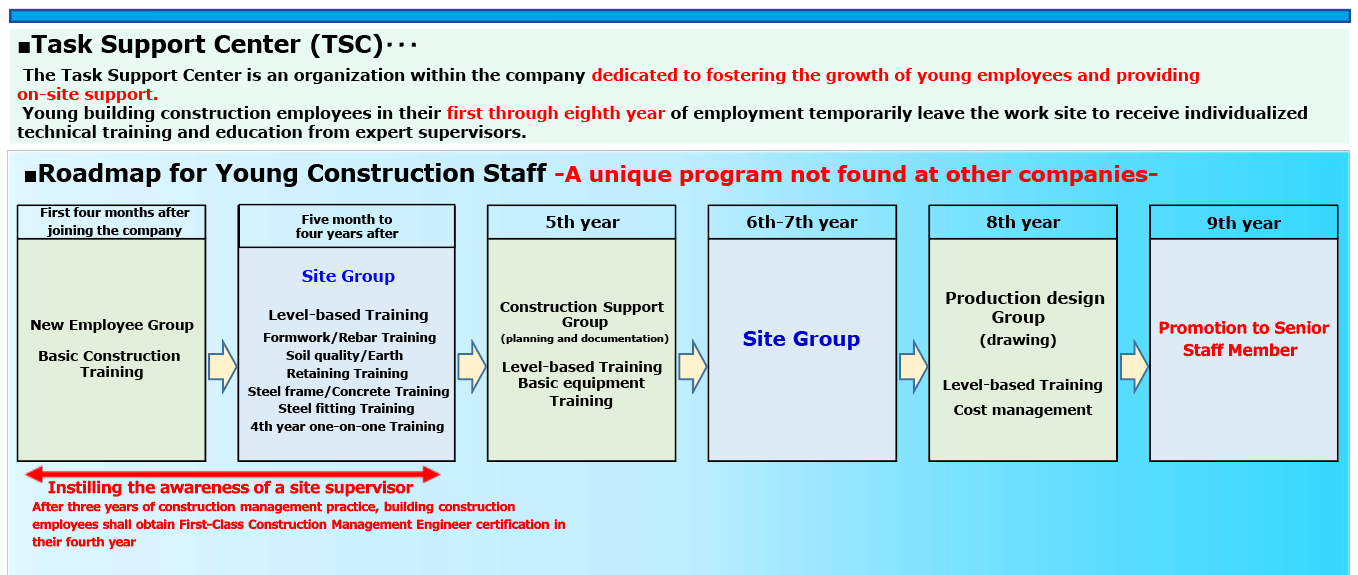
In the Building Construction Divisions Group, we established the "Task Support Center" in 2020 as a department where specialized instructors individually guide and educate construction staff in their first eight years, aiming to enhance technical skills and ensure optimal placement of personnel. For M&E and design positions, we also strive to improve the technical skills of young employees based on each respective development program.
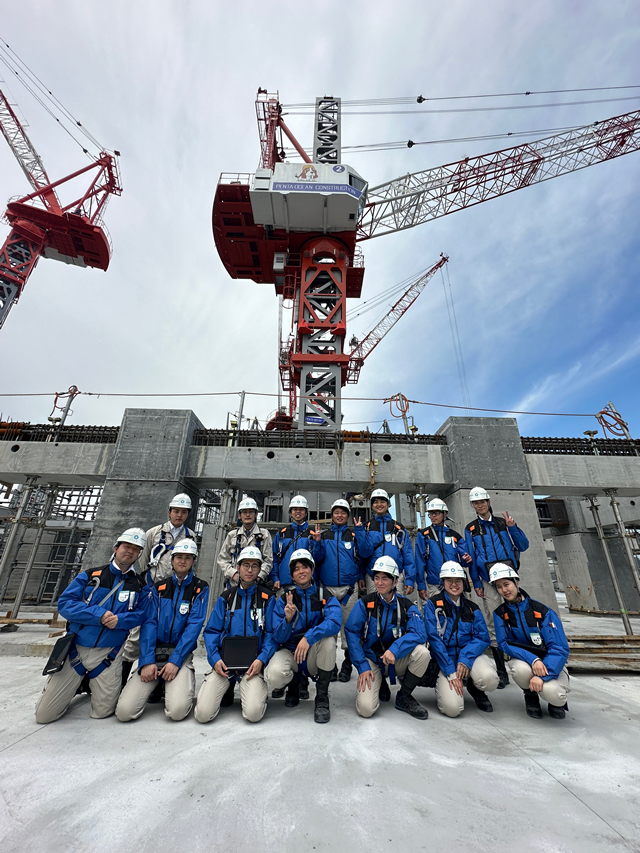
Foundation Training
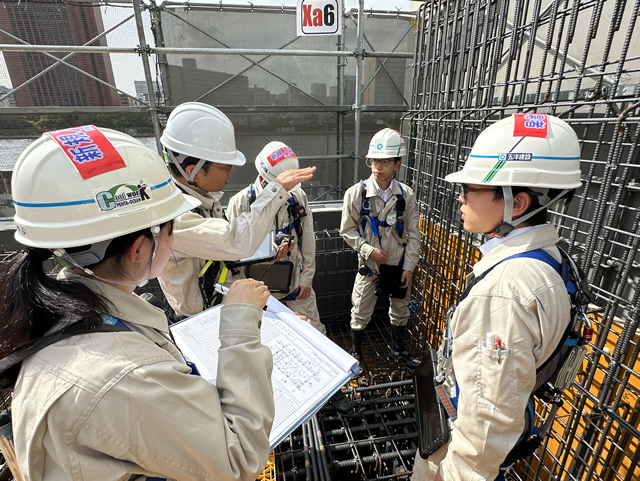
Corporate Administration Divisions Group
Intensive Training for Administrative Staff
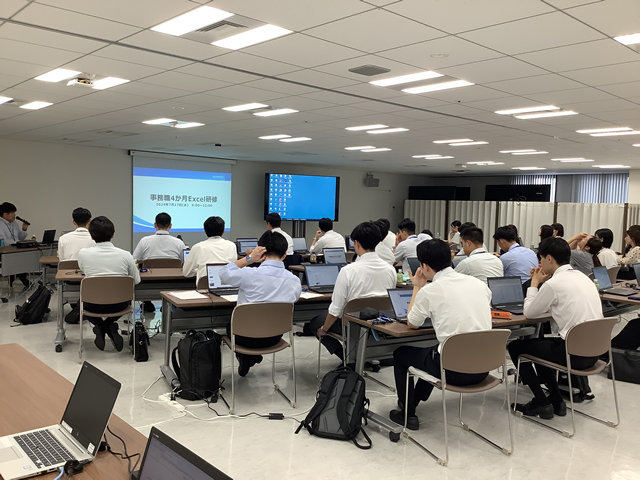
To broadly acquire the basic business skills required for administrative staff, all first-year employees are assigned to the Human Resources Division for the duration of the training period, assigned to headquarters, a branch office, and construction office for four-month periods. After learning the basics of administrative work, they receive their official work assignment in their second year at the Company. This provides each employee with equal learning opportunities and helps to raise the overall level of business capability.
At each site that they are assigned, under the guidance and follow-up of senior employees, they handle a variety of tasks and deepen their knowledge through practical experience. Based on the experience gained in the first year, from the second year onward, employees aim to further hone their specialized business knowledge and build their individual careers.
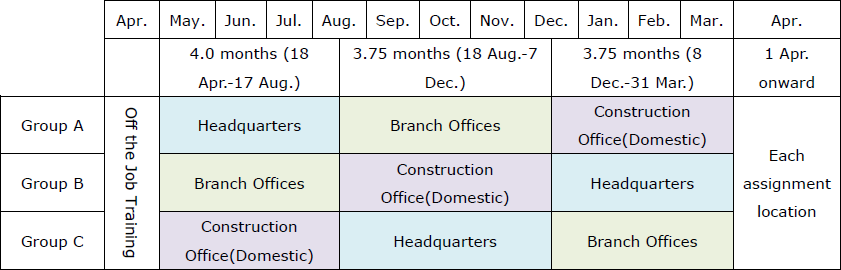
Specialized Training for Administrative Staff
We conduct training for new to mid-career employees to acquire the basic knowledge they should master to serve as administrative staff, aiming to further enhance and upgrade their assigned duties.
In their first year, through courses such as the Level 2 Construction Industry Accountant Seminar, employees acquire practical skills directly linked to their work, laying the foundation for the following year.
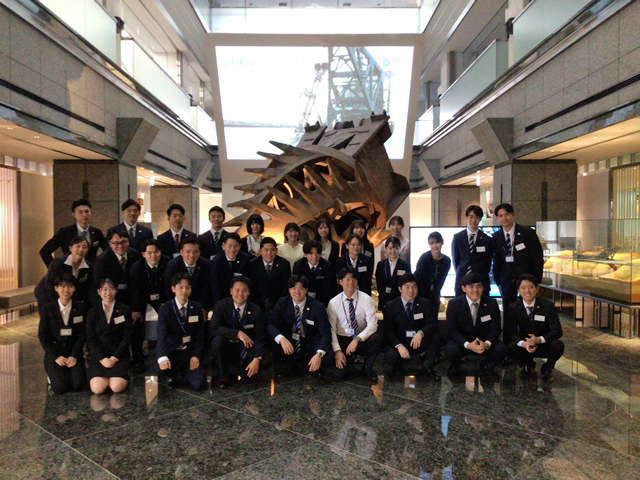
(after joining the Company)
Institute of Technology Tour
Technical Training for Young Employees by Senior Staff
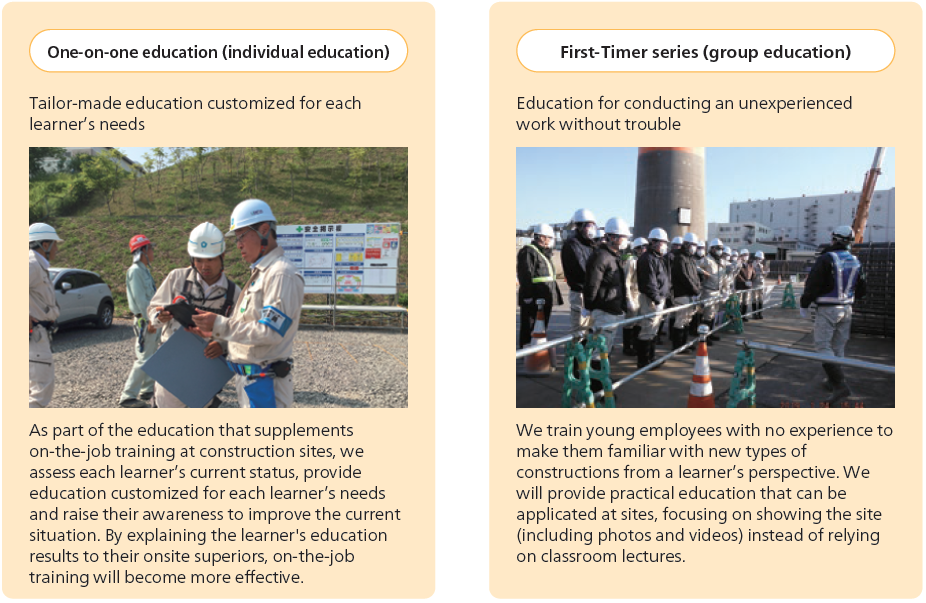
At the Safety and Quality Control Education Office, senior employees with extensive knowledge and experience serve as instructors, providing practical education (one-on-one and group training) to address various on-site situations, offering opportunities for technical inheritance and the growth of young employees.
Support for On-Site ICT Utilization
We support business efficiency and optimization by utilizing data and digital technology. By utilizing digital devices, we support improved business efficiency and technical capabilities through the digitization of construction management information and the activation of communication by speeding up data sharing.
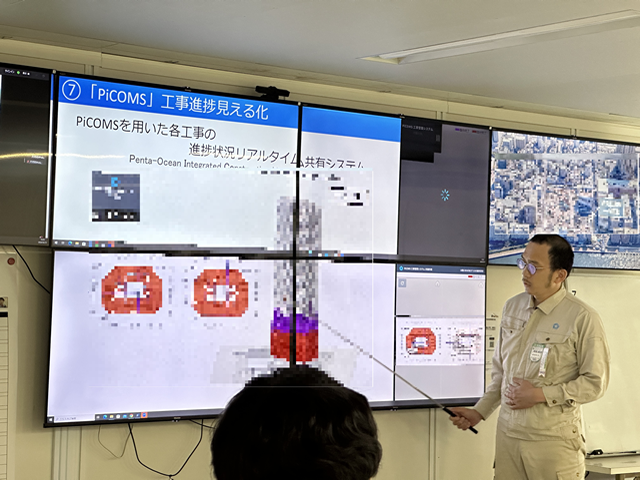
Sharing Using Multiple Large Monitors
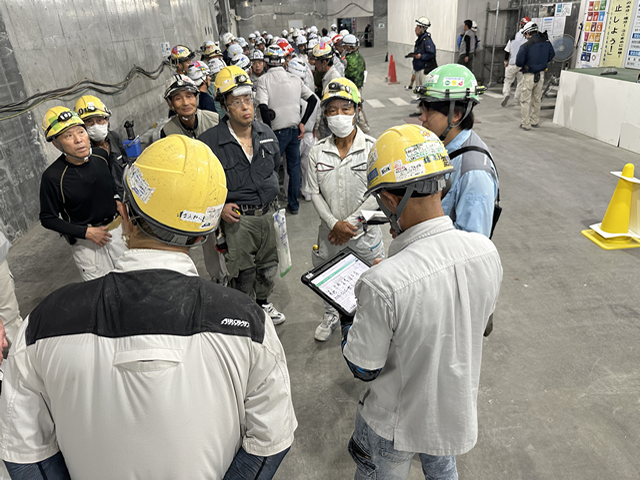
(hazard prediction) Using Smart Devices