This Page is Home SustainabilityReport / DataESG Data Sheet, Third Party Assurance
ESG Data Sheet, Third Party Assurance

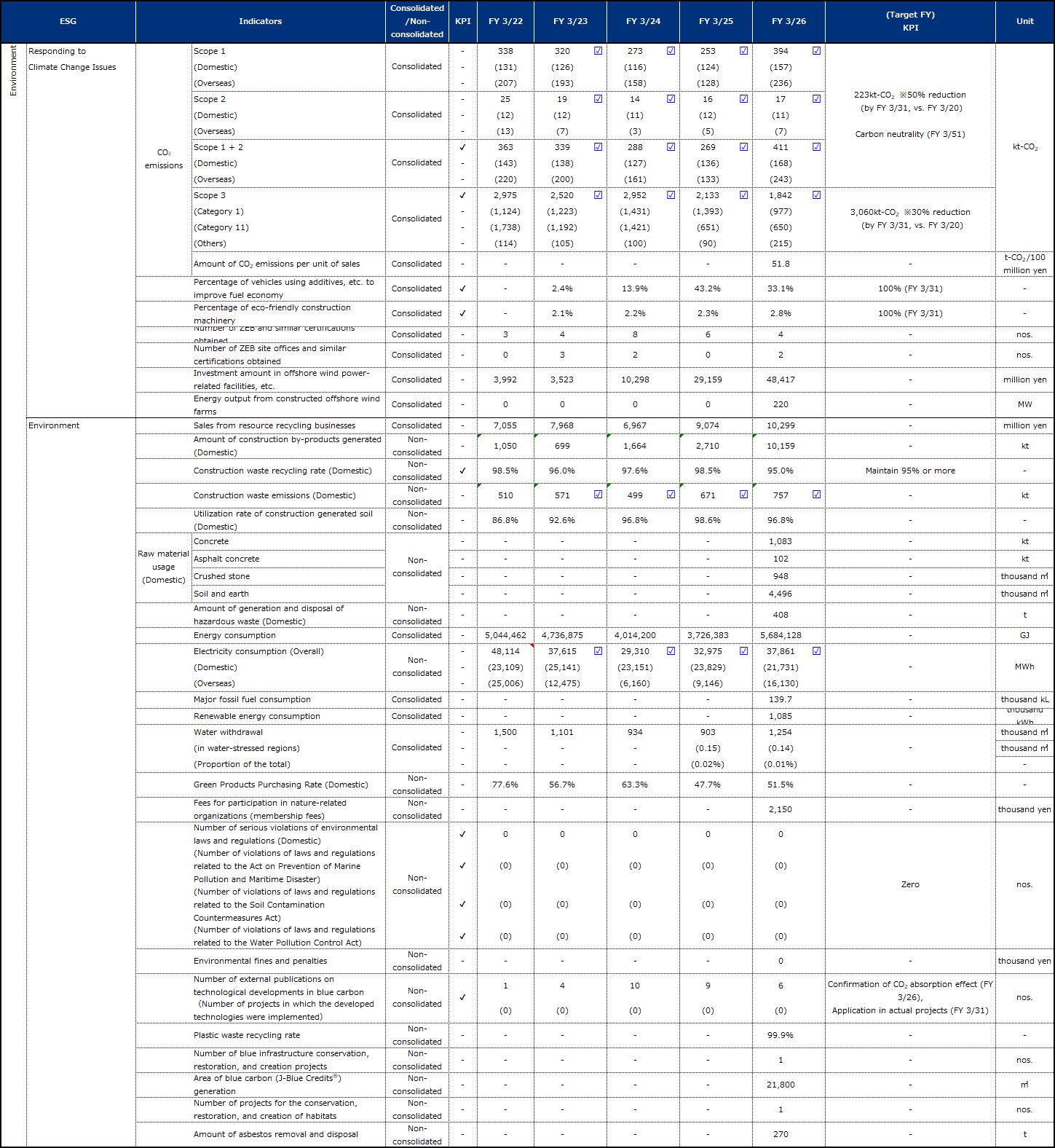
ESG Data sheet Values checked  obtained third-party assurance by Ernst & Young ShinNihon LLC.
Environment
Social
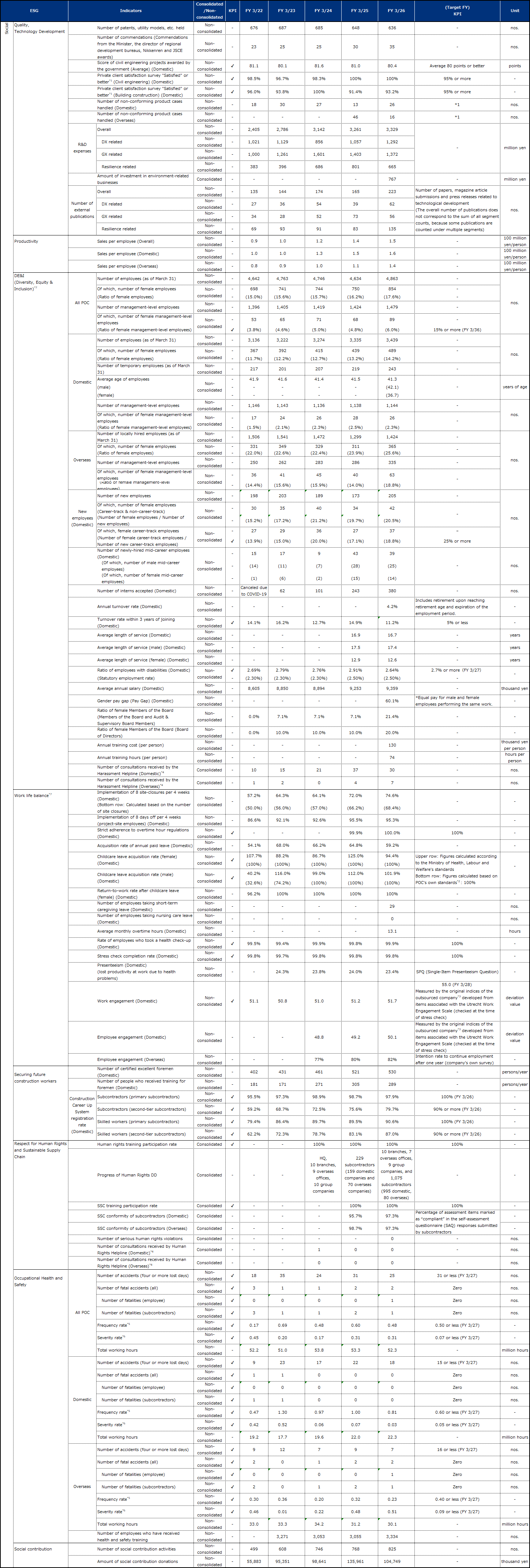
*1 Quality Management System (Reporting standards for overseas were unified with domestic from FY 3/25)
*2 Percentage of employees who took childcare leave, etc., out of the total number of employees whose leave eligibility period had reached its limit
*3 Stress check outsourced to: Advantage Risk Management Co., Ltd.
*4 Counted by each contact point based on the content of the consultation
*5 The frequency of accidents is represented by the number of fatalities and injuries due to industrial accidents per 1 million total working hours (The average value for domestic general construction companies in FY 3/26, according to a survey by the Ministry of Health, Labour and Welfare, is 1.89)
*6 The severity of the accident is represented by the number of lost working days per 1,000 total working hours (The average value for domestic general construction companies in FY 3/26, according to a survey by the Ministry of Health, Labour and Welfare, is 0.29)
*7 "(Domestic)" applies to employees hired in Japan
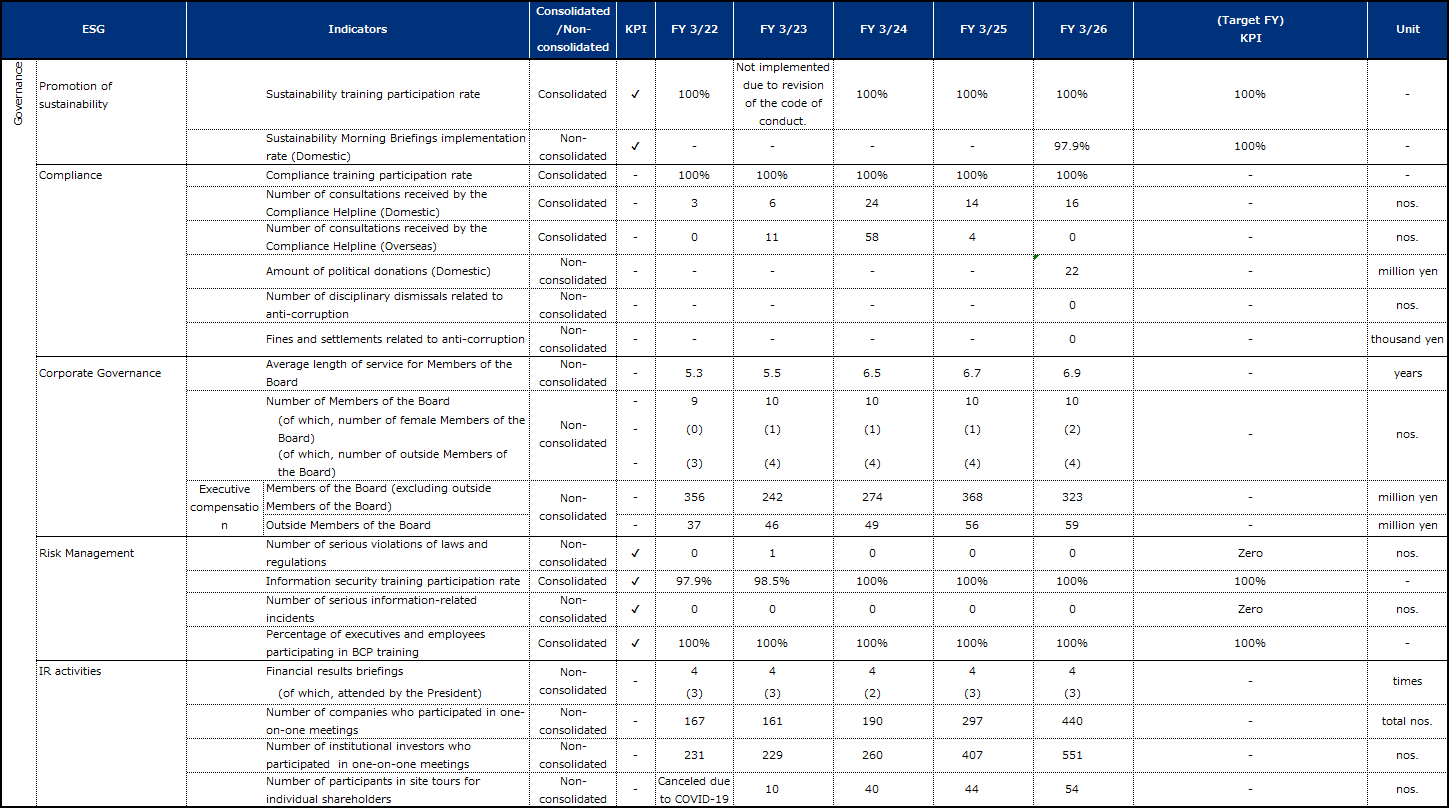
Calculation criteria
CO2 emissions
Scope1/2
Referenced laws, regulations, guidelines and emission coefficient
- GHG protocol
- "Act on Rational Use of Energy and Conversion into Non-Fossil Fuel, Etc."
- "Act on Promotion of Global Warming Countermeasures"
- "Table of heat generation and carbon emission coefficient by energy source" (METI)
- IEA Emission Factors 2024(International Energy Agency)
Up to FY 3/24, in certain fuels, we utilised the carbon emission coefficient based on the calculation method developed by the Japan Federation of Construction Contractors. Starting in FY 3/25, we switched to using the standard calorific values by energy type and carbon emission factors set by the Ministry of Economy, Trade and Industry.
Calculation method
- CO2 emissions are calculated by multiplying energy consumption (including crude oil, light oil, gas and electricity) by CO2 emission coefficient
- With regard to a portion of electricity/gas consumption (FY3/26: 4% of total electricity, 6% of gas) for which payment is not processed through payment service providers, the amount is estimated based on electricity/gas consumption per unit of sales.
- Calculation method for CO2 emissions from completed construction works by POC standalone basis
CO2 emissions from completed construction works by POC standalone basis = CO2 emissions from all construction works (excluding projects undertaken as a JV sub member)/ Net sales of all completed construction contracts (excluding projects undertaken as a JV sub member) x Net sales of completed construction contracts of POC standalone basis - Calculation method of CO2 emissions of POC group
CO2 emissions of POC group = CO2 emissions of POC standalone basis /Net sales of POC standalone basis x Net sales of POC Group
Up to FY 3/24, diesel fuel used for transporting construction waste was categorised under Scope 1. However, following partial automation of the calculation process and a subsequent review of the calculation method, the above fuel usage has been recategorised under Scope 3, Category 5 (Waste Generated in Operations) since FY 3/25. (The impact on the current reporting period is minimal.) Please note that this change has not been retroactively applied to prior years shown in the table above, as the impact is considered negligible.
Scope3
Referenced guidelines and emission intensity
- GHG Protocol
- Emissions unit value database for accounting of greenhouse gas emissions throughout the supply chain (Ministry of the Environment)
- LCI database IDEA v2 (Sustainable Management Promotion Organisation)
- Comprehensive Assessment System for Built Environment Efficiency (CASBEE) Evaluation Manual (Japan Sustainable Building Consortium)
Calculation method
-
Category 1 (purchased goods and services): CO2 emissions of POC standalone basis are calculated by multiplying the purchase quantities or price of the major construction materials (steel, concrete and cement) by emission intensity. CO2 emissions of POC Group are estimated by scaling the above standalone figure in proportion to sales volume.
From FY 3/24, regarding major construction materials (steel, concrete and cement), we use emission intensity provided by major suppliers where possible for calculation.
Starting from FY 3/25, CO2 emissions from the transportation of construction waste are included under Scope 3, Category 5 (Waste Generated in Operations). - Category 11 (use of sold products): Calculated by multiplying the total floor area of construction projects completed by POC Group in the relevant year by the emission intensity and the years of service life determined for each building use (CASBEE Evaluation Manual).
- Other categories include Categories 2, 3, 4, 5, 6, 7 and 12.
Environment related issues
Amount of construction generated waste
Referenced Laws and regulations
- Act on Waste Management and Public Cleansing
Calculation method
- Calculated based on manifests for all construction projects (excluding projects undertaken as a JV sub member) conducted by POC
Electricity consumption
Referenced laws and regulations
- "Act on Rational Use of Energy and Conversion into Non-Fossil Fuel, etc."
- Act on Promotion of Global Warming Countermeasures
Calculation method
- Calculated based on bills from power companies.
- With regard to a portion of electricity consumption (FY 3/26: 4% of the total) for which bill payment is not outsourced to payment service providers, the amount is estimated based on electricity consumption per unit of sales.
- Calculation method of electricity consumption from completed construction works by POC standalone basis
Electricity consumption from completed construction works by POC standalone basis = Electricity consumption from all construction works (excluding project undertaken as a JV sub member) /Net sales of all completed construction contracts (excluding projects undertaken as a JV sub member) x Net sales of completed construction contracts of POC standalone basis
Third Party Assurance
Items indicated with (☑) on the above ESG sheet were assured by Ernst & Young ShinNihon LLC.